FBA courses promise six-figure incomes with minimal work. The reality: about 50% of Amazon sellers profit less than $5,000 per year, and roughly 20% never turn a profit at all. The winners exist, some sellers genuinely build $50K-500K+ annual profit businesses, but they typically have significant capital, experience, and often luck with product selection. This guide covers what FBA actually costs and returns.
The companion book
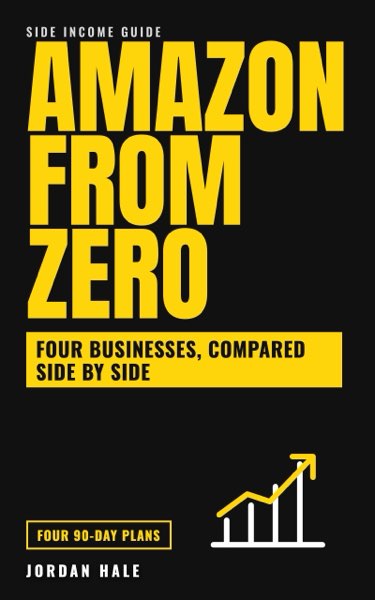
by Jordan Hale
FBA, Flex, KDP and Merch on Demand compared with real numbers, so you can pick the business that fits your capital, hours, and risk.
How Amazon FBA Fees Actually Work
Amazon takes a substantial cut of every sale. For a typical $25 product weighing 1 pound:
| Fee Type | Rate | On $25 Sale |
|---|---|---|
| Referral fee | 15% (most categories) | $3.75 |
| FBA fulfillment fee | $3.22-6.00+ (size/weight based) | $3.50 |
| Monthly storage | $0.87-2.40/cubic ft | $0.25 |
| Inbound shipping | Varies by origin | $0.75 |
| Total Amazon fees | $8.25 (33%) |
But that's not your total cost. A realistic breakdown includes:
- Product cost: Typically 25-40% of sale price for sourced products
- PPC advertising: Often 10-25% of revenue for new products; lower for established listings
- Returns/refunds: 5-15% depending on category (apparel is higher)
- Product liability insurance: Required over $10K/month; ~$500-1500/year
- Professional seller account: $39.99/month
What to Realistically Expect
- Time required: 10-20 hours/week for product research, supplier management, and listing optimization during active selling. Less once established, but requires ongoing monitoring.
- Earnings range: Net profit margins typically 15-25% of revenue after all costs. A product selling $10,000/month might net $1,500-2,500 in actual profit. Many sellers operate at 10-15% margins or break even for months while building rank.
- Main tradeoffs: Significant capital requirement ($3,000-15,000 minimum to start properly). Amazon controls your business, account suspensions, fee increases, and policy changes can devastate margins. Competition is intense in most categories.
Realistic Startup Capital
FBA is not a low-capital business despite what courses claim. Here's what it actually costs to launch properly:
| Expense | Minimum | Comfortable |
|---|---|---|
| Initial inventory (500-1000 units) | $1,500 | $3,000-5,000 |
| Product samples (testing suppliers) | $200 | $500 |
| UPC/GTIN codes | $30 | $250 |
| Product photography | $100 | $300-500 |
| Launch PPC budget (first 2-3 months) | $500 | $1,500-3,000 |
| Software tools (Helium 10, Jungle Scout, etc.) | $100 | $300-500 |
| Total to launch one product | $2,500-3,000 | $6,000-10,000 |
Most experienced sellers recommend launching with at least $5,000-10,000 to account for mistakes, reorders, and having enough runway to optimize.
Profit Scenarios: Best Case to Worst Case
Profitable product (top 20% of sellers)
Selling 300 units/month at $30 = $9,000 revenue. Product cost $4, Amazon fees $10, PPC $1,500. Net profit: $1,800/month (20% margin). This is genuinely good FBA performance.
Break-even product (common)
Selling 150 units/month at $25 = $3,750 revenue. Product cost $5, Amazon fees $8, PPC $1,200. Net profit: $-150/month. Many products hover here, especially during launch phases.
Failed product (20%+ of attempts)
Selling 50 units/month at $20 = $1,000 revenue. Product cost $4, Amazon fees $7, PPC $800. Net loss: $-650/month, plus $3,000+ in unsold inventory. Long-term storage fees add up.
Calculate Your FBA Profits
Input your product costs and expected sales to see real profit margins after Amazon's cut.
Open FBA CalculatorCommon Pitfalls
Underestimating PPC costs
New products need advertising to rank. Budget 25-40% of revenue for PPC in months 1-3. Many sellers run out of cash before products gain organic traction.
Choosing oversaturated niches
Garlic presses, phone cases, resistance bands, these categories have thousands of sellers competing on price. Differentiation is nearly impossible; margins race to zero.
Ignoring seasonality
Many products sell well in Q4 but poorly January-March. Storage fees on unsold inventory compound during slow months. Plan cash flow for full-year cycles, not just peak performance.
Account suspension risk
Amazon can suspend accounts for policy violations, negative reviews, or IP complaints, sometimes incorrectly. If selling is your only income, this risk is substantial. Appeals can take weeks.
Frequently Asked Questions
How much can you realistically make with Amazon FBA?
About 20% of sellers make $1,000-10,000/month in revenue (not profit). Net profit is typically 15-25% of revenue. A seller doing $5,000/month in sales might net $750-1,250 after all costs. Reaching $50K+/year profit usually requires $200K+ in annual revenue across multiple products.
Is Amazon FBA still profitable in 2026?
Yes, but margins have compressed. Fees have increased, PPC costs are higher, and competition is more intense than 5 years ago. Private label still works but requires more capital, better product selection, and stronger operations than before.
How long does it take to be profitable?
Most products take 3-6 months to become profitable after launch PPC costs stabilize. Full ROI on initial investment typically takes 6-12 months for successful products. Failed products may never recoup their investment.
Is FBA better than dropshipping?
Different tradeoffs. FBA requires more capital but offers higher margins and better customer experience. Dropshipping has lower startup costs but razor-thin margins and fulfillment issues. Neither is "easier", both require significant work and capital to succeed.
What about retail arbitrage or wholesale?
Retail arbitrage (buying clearance items to resell) requires less capital but more time and has inventory limits. Wholesale (buying established brands in bulk) is lower risk than private label but margins are tighter (10-20%). Both can work but scale differently than private label.
How do I find good products to sell?
Most sellers use tools like Helium 10 or Jungle Scout to analyze demand, competition, and profitability. Look for products with $3,000-15,000 monthly revenue, under 200 reviews on top listings, and margins above 30% after all costs. Avoid categories with dominant brands or commodity pricing.
Can I start FBA while working a full-time job?
Yes, many sellers start this way. Initial product research and launch take 5-15 hours weekly. Once running, maintenance is 3-8 hours weekly depending on sales volume. The main challenge is having enough capital to absorb early losses while waiting for products to rank.
